Metaphorical Drawings for Building a City Through Art Traceable
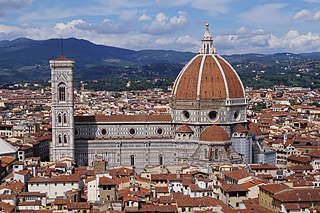
Architecture (Latin architectura, from the Greek ἀρχιτέκτων arkhitekton "architect", from ἀρχι- "chief" and τέκτων "creator") is both the process and the product of planning, designing, and constructing buildings or other structures.[three] Architectural works, in the material class of buildings, are oft perceived equally cultural symbols and every bit works of fine art. Historical civilizations are ofttimes identified with their surviving architectural achievements.[four]
The practice, which began in the prehistoric era, has been used as a way of expressing culture for civilizations on all vii continents.[5] For this reason, architecture is considered to exist a form of art. Texts on architecture accept been written since ancient times. The earliest surviving text on architectural theories is the 1st century AD treatise De architectura by the Roman builder Vitruvius, according to whom a skilful building embodies firmitas, utilitas , and venustas (durability, utility, and dazzler). Centuries subsequently, Leon Battista Alberti adult his ideas farther, seeing beauty equally an objective quality of buildings to be institute in their proportions. Giorgio Vasari wrote Lives of the Most Splendid Painters, Sculptors, and Architects and put forrard the idea of style in the Western arts in the 16th century. In the 19th century, Louis Sullivan declared that "form follows function". "Function" began to replace the classical "utility" and was understood to include not only practical merely also aesthetic, psychological and cultural dimensions. The idea of sustainable architecture was introduced in the late 20th century.
Architecture began as rural, oral vernacular architecture that developed from trial and error to successful replication. Ancient urban architecture was preoccupied with building religious structures and buildings symbolizing the political ability of rulers until Greek and Roman architecture shifted focus to civic virtues. Indian and Chinese compages influenced forms all over Asia and Buddhist architecture in particular took various local flavors. In fact, During the European Center Ages, pan-European styles of Romanesque and Gothic cathedrals and abbeys emerged while the Renaissance favored Classical forms implemented by architects known by name. After, the roles of architects and engineers became separated. Mod architecture began subsequently World War I as an avant-garde motility that sought to develop a completely new style appropriate for a new post-state of war social and economical order focused on meeting the needs of the centre and working classes. Emphasis was put on modern techniques, materials, and simplified geometric forms, paving the manner for high-ascension superstructures. Many architects became disillusioned with modernism which they perceived equally ahistorical and anti-aesthetic, and postmodern and contemporary architecture developed.
Over the years, the field of architectural structure has branched out to include everything from ship blueprint to interior decorating.
Definitions
Architecture tin can hateful:
- A general term to depict buildings and other physical structures.[6]
- The fine art and science of designing buildings and (some) nonbuilding structures.[6]
- The style of design and method of structure of buildings and other physical structures.[6]
- A unifying or coherent course or structure.[7]
- Knowledge of art, science, technology, and humanity.[6]
- The design activity of the builder,[six] from the macro-level (urban design, landscape architecture) to the micro-level (structure details and furniture). The practice of the architect, where architecture means offer or rendering professional services in connectedness with the design and structure of buildings, or congenital environments.[8]
Theory of architecture
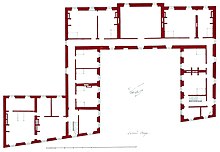
Plan of the second floor (attic storey) of the Hôtel de Brionne in Paris – 1734.
The philosophy of compages is a branch of philosophy of art, dealing with aesthetic value of architecture, its semantics and in relation with development of culture. Many philosophers and theoreticians from Plato to Michel Foucault, Gilles Deleuze,[9] Robert Venturi and Ludwig Wittgenstein have concerned themselves with the nature of architecture and whether or non architecture is distinguished from edifice.
Historic treatises
The earliest surviving written work on the subject of architecture is De architectura by the Roman architect Vitruvius in the early 1st century AD.[10] Co-ordinate to Vitruvius, a skilful building should satisfy the three principles of firmitas, utilitas, venustas ,[11] [12] commonly known by the original translation – compactness, commodity and please. An equivalent in modernistic English would be:
- Durability – a building should stand upwardly robustly and remain in good condition
- Utility – information technology should be suitable for the purposes for which it is used
- Beauty – it should be aesthetically pleasing
Co-ordinate to Vitruvius, the architect should strive to fulfill each of these three attributes as well as possible. Leon Battista Alberti, who elaborates on the ideas of Vitruvius in his treatise, De re aedificatoria, saw beauty primarily every bit a matter of proportion, although decoration also played a part. For Alberti, the rules of proportion were those that governed the idealized man effigy, the Golden mean. The most important aspect of beauty was, therefore, an inherent function of an object, rather than something practical superficially, and was based on universal, recognizable truths. The notion of style in the arts was non developed until the 16th century, with the writing of Giorgio Vasari.[xiii] By the 18th century, his Lives of the Most Excellent Painters, Sculptors, and Architects had been translated into Italian, French, Spanish, and English language.
In the 16th century, Italian Mannerist builder, painter and theorist Sebastiano Serlio wrote Tutte L'Opere D'Architettura et Prospetiva (Consummate Works on Architecture and Perspective). This treatise exerted immense influence throughout Europe, being the starting time handbook that emphasized the practical rather than the theoretical aspects of architecture, and information technology was the first to itemize the 5 orders.[xiv]
In the early 19th century, Augustus Welby Northmore Pugin wrote Contrasts (1836) that, as the title suggested, assorted the modern, industrial globe, which he disparaged, with an idealized prototype of neo-medieval world. Gothic architecture, Pugin believed, was the only "true Christian form of architecture."[xv] The 19th-century English art critic, John Ruskin, in his Seven Lamps of Architecture, published 1849, was much narrower in his view of what constituted architecture. Compages was the "art which and then disposes and adorns the edifices raised by men … that the sight of them" contributes "to his mental health, power, and pleasance".[16] For Ruskin, the aesthetic was of overriding significance. His work goes on to state that a building is non truly a piece of work of architecture unless it is in some manner "adorned". For Ruskin, a well-constructed, well-proportioned, functional building needed string courses or rustication, at the very least.[16]
On the difference between the ideals of compages and mere construction, the renowned 20th-century architect Le Corbusier wrote: "You apply stone, wood, and concrete, and with these materials y'all build houses and palaces: that is construction. Ingenuity is at work. Just suddenly you touch my heart, you do me good. I am happy and I say: This is beautiful. That is Compages".[17] Le Corbusier'due south gimmicky Ludwig Mies van der Rohe said "Architecture starts when you lot advisedly put two bricks together. There it begins."[eighteen]

Modernistic concepts
The notable 19th-century architect of skyscrapers, Louis Sullivan, promoted an overriding precept to architectural design: "Form follows part". While the notion that structural and artful considerations should exist entirely subject to functionality was met with both popularity and skepticism, information technology had the effect of introducing the concept of "function" in identify of Vitruvius' "utility". "Role" came to be seen as encompassing all criteria of the employ, perception and enjoyment of a edifice, not only practical simply also aesthetic, psychological and cultural.
Nunzia Rondanini stated, "Through its aesthetic dimension architecture goes beyond the functional aspects that information technology has in common with other man sciences. Through its own particular style of expressing values, architecture tin can stimulate and influence social life without presuming that, in and of itself, it will promote social development.... To restrict the meaning of (architectural) ceremonial to art for fine art'southward sake is not only reactionary; it can also be a purposeless quest for perfection or originality which degrades grade into a mere instrumentality".[19]
Amongst the philosophies that accept influenced mod architects and their approach to building design are Rationalism, Empiricism, Structuralism, Poststructuralism, Deconstruction and Phenomenology.
In the tardily 20th century a new concept was added to those included in the compass of both construction and role, the consideration of sustainability, hence sustainable architecture. To satisfy the gimmicky ethos a building should be constructed in a manner which is environmentally friendly in terms of the product of its materials, its impact upon the natural and congenital environment of its surrounding area and the demands that it makes upon non-sustainable power sources for heating, cooling, water and waste direction, and lighting.
History
Origins and colloquial compages
-

In Norway: forest and elevated-level
-

-

Building first evolved out of the dynamics between needs (shelter, security, worship, etc.) and means (bachelor building materials and attendant skills). As human being cultures developed and noesis began to be formalized through oral traditions and practices, edifice became a craft, and "architecture" is the proper name given to the almost highly formalized and respected versions of that arts and crafts. It is widely assumed that architectural success was the product of a process of trial and error, with progressively less trial and more replication as the results of the process proved increasingly satisfactory. What is termed vernacular compages continues to be produced in many parts of the world.
Prehistoric compages
-

Göbekli Tepe from Turkey, founded in tenth millennium BC and abandoned in 8th millennium BC
-

Miniature of a regular Cucuteni-Trypillian firm, full of ceramic vessels
-
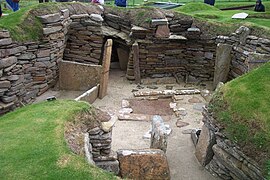
Early human settlements were by and large rural. Hence, Expending economies resulted in the creation of urban areas which in some cases grew and evolved very rapidly, such as that of Çatal Höyük in Anatolia and Mohenjo Daro of the Indus Valley Civilization in modern-day Islamic republic of pakistan.
Neolithic settlements and "cities" include Göbekli Tepe and Çatalhöyük in Turkey, Jericho in the Levant, Mehrgarh in Islamic republic of pakistan, Knap of Howar and Skara Brae, Orkney Islands, Scotland, and the Cucuteni-Trypillian culture settlements in Romania, Moldova and Ukraine.
Ancient compages


In many ancient civilizations such as those of Arab republic of egypt and Mesopotamia, compages and urbanism reflected the constant appointment with the divine and the supernatural, and many aboriginal cultures resorted to monumentality in compages to symbolically represent the political ability of the ruler or the country itself.
The architecture and urbanism of the Classical civilizations such as the Greek and the Roman evolved from borough ideals rather than religious or empirical ones and new building types emerged. As the Architectural "fashion" adult in the form of the Classical orders. Roman compages was influenced past Greek compages every bit they incorporated many Greek elements into their building practices.[20]
Texts on architecture have been written since aboriginal times. These texts provided both general advice and specific formal prescriptions or canons. Some examples of canons are found in the writings of the 1st-century BCE Roman Builder Vitruvius. Some of the almost important early examples of canonic compages are religious.
Asian compages
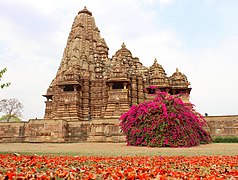

The compages of unlike parts of Asia developed differently than Europe; and each of Buddhist, Hindu and Sikh architecture had different characteristics. In fact, Different Indian and Chinese architecture which had great influence on the surrounding regions, Japanese architecture did not. Some Asian architecture showed great regional variety such as Buddhist architecture, in particular. Moreover, other architectural achievements in Asia is the Hindu temple compages, which developed from around the 5th century CE, is in theory governed by concepts laid downwards in the Shastras, and is concerned with expressing the macrocosm and the microcosm.
In many Asian countries, pantheistic religion led to architectural forms that were designed specifically to raise the natural landscape. Also, the grandest houses were relatively lightweight structures mainly using wood until recent times, and there are few survivals of smashing age. Buddhism was associated with a move to stone and brick religious structures, probably kickoff as rock-cut compages, which has often survived very well.
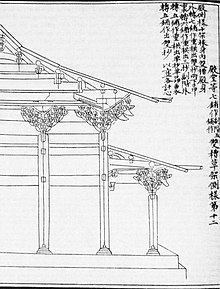
Early on Asian writings on architecture include the Kao Gong Ji of Prc from the 7th–5th centuries BCE; the Shilpa Shastras of ancient Bharat; Manjusri Vasthu Vidya Sastra of Sri Lanka and Araniko of Nepal .
Islamic architecture
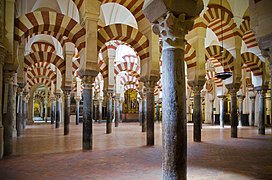
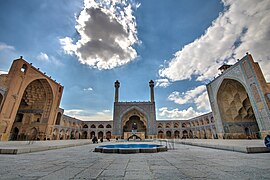
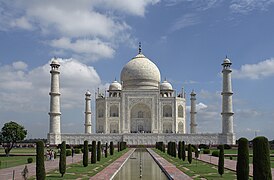
Islamic architecture began in the seventh century CE, incorporating architectural forms from the ancient Middle East and Byzantium, but likewise developing features to suit the religious and social needs of the society. Examples can be plant throughout the Middle East, Turkey, N Africa, the Indian Sub-continent and in parts of Europe, such as Spain, Albania, and the Balkan States, as the consequence of the expansion of the Ottoman Empire. [21] [22]
Middle Ages

In Europe during the Medieval menses, guilds were formed past craftsmen to organize their trades and written contracts accept survived, particularly in relation to ecclesiastical buildings. The role of architect was usually i with that of main mason, or Magister lathomorum as they are sometimes described in contemporary documents.
The major architectural undertakings were the buildings of abbeys and cathedrals. From about 900 CE onward, the movements of both clerics and tradesmen carried architectural knowledge across Europe, resulting in the pan-European styles Romanesque and Gothic.
As well, a pregnant part of the Middle Ages architectural heritage is numerous fortifications across the continent. From the Balkans to Kingdom of spain, and from Malta to Estonia, these buildings stand for an important part of European heritage.
Renaissance and the builder
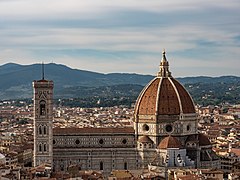


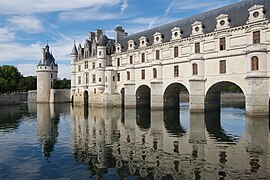
In Renaissance Europe, from about 1400 onwards, there was a revival of Classical learning accompanied by the evolution of Renaissance humanism, which placed greater emphasis on the role of the private in society than had been the case during the Medieval period. Buildings were ascribed to specific architects – Brunelleschi, Alberti, Michelangelo, Palladio – and the cult of the individual had begun. In that location was nevertheless no dividing line between artist, builder and engineer, or any of the related vocations, and the appellation was oft i of regional preference.
A revival of the Classical manner in architecture was accompanied by a burgeoning of science and applied science, which affected the proportions and structure of buildings. At this stage, it was still possible for an artist to design a bridge as the level of structural calculations involved was within the scope of the generalist.
Early on modern and the industrial age
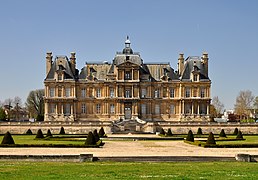


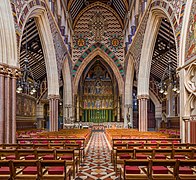
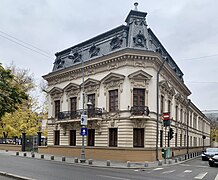
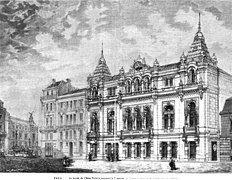

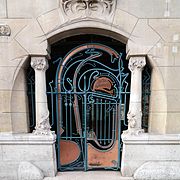
With the emerging noesis in scientific fields and the rise of new materials and technology, compages and engineering began to separate, and the builder began to concentrate on aesthetics and the humanist aspects, ofttimes at the expense of technical aspects of building design. There was also the rise of the "gentleman builder" who unremarkably dealt with wealthy clients and concentrated predominantly on visual qualities derived usually from historical prototypes, typified by the many state houses of Dandy Britain that were created in the Neo Gothic or Scottish baronial styles. Formal architectural grooming in the 19th century, for case at École des Beaux-Arts in France, gave much emphasis to the production of beautiful drawings and little to context and feasibility.
Meanwhile, the Industrial Revolution laid open up the door for mass production and consumption. Aesthetics became a criterion for the eye grade as ornamented products, once within the province of expensive craftsmanship, became cheaper nether machine production.
Vernacular architecture became increasingly ornamental. Housebuilders could use current architectural design in their piece of work past combining features found in pattern books and architectural journals.
Modernism
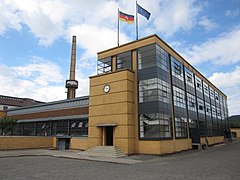
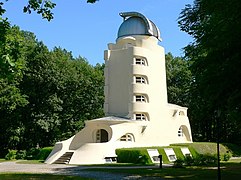

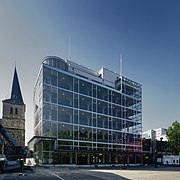
Around the showtime of the 20th century, general dissatisfaction with the emphasis on revivalist architecture and elaborate decoration gave ascension to many new lines of thought that served as precursors to Modernistic architecture. Notable among these is the Deutscher Werkbund, formed in 1907 to produce better quality machine-made objects. The rise of the profession of industrial pattern is normally placed hither. Post-obit this lead, the Bauhaus school, founded in Weimar, Frg in 1919, redefined the architectural premises prior set up throughout history, viewing the creation of a building as the ultimate synthesis—the apex—of art, craft, and technology.
When modern architecture was first practiced, it was an advanced movement with moral, philosophical, and aesthetic underpinnings. Immediately afterwards World War I, pioneering modernist architects sought to develop a completely new manner appropriate for a new post-state of war social and economic social club, focused on coming together the needs of the middle and working classes. They rejected the architectural do of the academic refinement of historical styles which served the rapidly declining aristocratic society. The approach of the Modernist architects was to reduce buildings to pure forms, removing historical references and ornamentation in favor of functional details. Buildings displayed their functional and structural elements, exposing steel beams and physical surfaces instead of hiding them behind decorative forms. Architects such as Frank Lloyd Wright developed organic architecture, in which the form was defined by its surroundings and purpose, with an aim to promote harmony between homo home and the natural world with prime examples being Robie Firm and Fallingwater.
Architects such as Mies van der Rohe, Philip Johnson and Marcel Breuer worked to create beauty based on the inherent qualities of edifice materials and modern construction techniques, trading traditional historic forms for simplified geometric forms, celebrating the new ways and methods made possible past the Industrial Revolution, including steel-frame construction, which gave birth to high-ascension superstructures. Fazlur Rahman Khan's development of the tube structure was a technological break-through in building ever higher. Past mid-century, Modernism had morphed into the International Style, an aesthetic epitomized in many ways by the Twin Towers of New York'south World Trade Center designed by Minoru Yamasaki.
Postmodernism

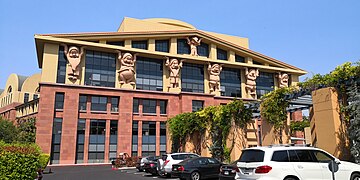


Many architects resisted modernism, finding information technology devoid of the decorative richness of historical styles. As the first generation of modernists began to dice after World War Ii, the second generation of architects including Paul Rudolph, Marcel Breuer, and Eero Saarinen tried to aggrandize the aesthetics of modernism with Brutalism, buildings with expressive sculpture façades made of unfinished concrete. But an even younger postwar generation critiqued modernism and Brutalism for being besides austere, standardized, monotone, and non taking into account the richness of human experience offered in historical buildings beyond fourth dimension and in unlike places and cultures.
One such reaction to the cold artful of modernism and Brutalism is the school of metaphoric architecture, which includes such things as bio morphism and zoomorphic architecture, both using nature as the primary source of inspiration and blueprint. While information technology is considered by some to be merely an aspect of postmodernism, others consider it to exist a school in its own correct and a afterward development of expressionist compages.[24]
Beginning in the late 1950s and 1960s, architectural phenomenology emerged as an of import movement in the early on reaction against modernism, with architects like Charles Moore in the United States, Christian Norberg-Schulz in Norway, and Ernesto Nathan Rogers and Vittorio Gregotti, Michele Valori, Bruno Zevi in Italy, who collectively popularized an interest in a new contemporary architecture aimed at expanding human experience using historical buildings as models and precedents.[25] Postmodernism produced a manner that combined contemporary edifice technology and cheap materials, with the aesthetics of older pre-modern and non-modernistic styles, from loftier classical compages to pop or vernacular regional building styles. Robert Venturi famously defined postmodern architecture every bit a "busy shed" (an ordinary building which is functionally designed inside and embellished on the outside) and upheld it against modernist and brutalist "ducks" (buildings with unnecessarily expressive tectonic forms).[26]
Architecture today


Since the 1980s, as the complexity of buildings began to increase (in terms of structural systems, services, energy and technologies), the field of architecture became multi-disciplinary with specializations for each project type, technological expertise or projection delivery methods. Moreover, there has been an increased separation of the 'blueprint' architect [Notes 1] from the 'project' builder who ensures that the project meets the required standards and deals with matters of liability.[Notes 2] The preparatory processes for the design of any large building have become increasingly complicated, and require preliminary studies of such matters equally durability, sustainability, quality, money, and compliance with local laws. A large construction can no longer be the blueprint of one person but must be the piece of work of many. Modernism and Postmodernism have been criticized by some members of the architectural profession who experience that successful architecture is non a personal, philosophical, or aesthetic pursuit past individualists; rather it has to consider everyday needs of people and use engineering to create livable environments, with the design process existence informed by studies of behavioral, environmental, and social sciences.
Environmental sustainability has become a mainstream issue, with a profound effect on the architectural profession. Many developers, those who support the financing of buildings, take become educated to encourage the facilitation of environmentally sustainable design, rather than solutions based primarily on immediate cost. Major examples of this can be found in passive solar building design, greener roof designs, biodegradable materials, and more attention to a structure'due south energy usage. This major shift in architecture has also changed compages schools to focus more on the surroundings. There has been an acceleration in the number of buildings that seek to meet green building sustainable design principles. Sustainable practices that were at the core of vernacular architecture increasingly provide inspiration for environmentally and socially sustainable contemporary techniques.[27] The U.S. Dark-green Building Council's LEED (Leadership in Energy and Environmental Blueprint) rating organization has been instrumental in this.[28] [ quantify ]
Meantime, the contempo movements of New Urbanism, Metaphoric architecture, Complementary architecture and New Classical compages promote a sustainable approach towards construction that appreciates and develops smart growth, architectural tradition and classical blueprint.[29] [30] This in contrast to modernist and globally compatible compages, as well as leaning against alone housing estates and suburban sprawl.[31] Glass curtain walls, which were the hallmark of the ultra modern urban life in many countries surfaced even in developing countries similar Nigeria where international styles had been represented since the mid 20th Century mostly considering of the leanings of strange-trained architects.[32]
Other types of architecture
Landscape compages
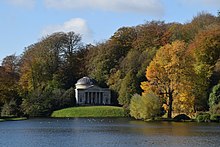
Mural architecture is the design of outdoor public areas, landmarks, and structures to achieve environmental, social-behavioral, or aesthetic outcomes.[33] Information technology involves the systematic investigation of existing social, ecological, and soil conditions and processes in the landscape, and the pattern of interventions that volition produce the desired outcome. The scope of the profession includes landscape design; site planning; stormwater direction; ecology restoration; parks and recreation planning; visual resource management; green infrastructure planning and provision; and private estate and residence landscape master planning and blueprint; all at varying scales of design, planning and management. A practitioner in the profession of landscape architecture is called a landscape architect.
Interior architecture
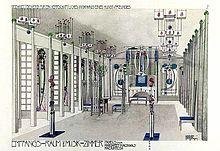
Charles Rennie Mackintosh – Music Room 1901
Interior architecture is the design of a infinite which has been created by structural boundaries and the human being interaction within these boundaries. It tin can also be the initial design and plan for apply, so afterwards redesigned to arrange a inverse purpose, or a significantly revised design for adaptive reuse of the building shell.[34] The latter is ofttimes function of sustainable compages practices, conserving resources through "recycling" a structure by adaptive redesign. Generally referred to as the spatial art of environmental design, class and exercise, interior compages is the process through which the interiors of buildings are designed, concerned with all aspects of the man uses of structural spaces. Put only, interior architecture is the blueprint of an interior in architectural terms.

Body programme of a send showing the hull form
Naval architecture, also known equally naval engineering, is an engineering discipline dealing with the engineering design process, shipbuilding, maintenance, and operation of marine vessels and structures.[35] [36] Naval architecture involves bones and applied enquiry, design, development, design evaluation and calculations during all stages of the life of a marine vehicle. Preliminary design of the vessel, its detailed design, structure, trials, operation and maintenance, launching and dry out-docking are the main activities involved. Ship design calculations are too required for ships being modified (by ways of conversion, rebuilding, modernization, or repair). Naval architecture also involves the formulation of safety regulations and damage control rules and the blessing and certification of ship designs to meet statutory and non-statutory requirements.
Urban design
Urban pattern is the process of designing and shaping the physical features of cities, towns, and villages. In dissimilarity to architecture, which focuses on the design of individual buildings, urban design deals with the larger scale of groups of buildings, streets and public spaces, whole neighborhoods and districts, and entire cities, with the goal of making urban areas functional, attractive, and sustainable.[37]
Urban blueprint is an interdisciplinary field that utilizes elements of many built environment professions, including mural architecture, urban planning, architecture, civil applied science and municipal engineering.[38] Information technology is mutual for professionals in all these disciplines to do urban design. In more recent times different sub-subfields of urban pattern take emerged such as strategic urban blueprint, mural urbanism, water-sensitive urban design, and sustainable urbanism.
Metaphorical "architectures"
"Architecture" is used as a metaphor for many modern techniques or fields for structuring abstractions. These include:
- Calculator architecture, a prepare of rules and methods that draw the functionality, organization, and implementation of computer systems, with software architecture, hardware architecture and network architecture covering more specific aspects.
- Business architecture, divers as "a pattern of the enterprise that provides a common understanding of the arrangement and is used to marshal strategic objectives and tactical demands",[39] Enterprise architecture is some other term.
- Cognitive architecture theories about the structure of the homo mind
- System architecture a conceptual model that defines the construction, beliefs, and more views of any type of system.[forty]
Seismic architecture
The term 'seismic compages' or 'earthquake architecture' was first introduced in 1985 by Robert Reitherman.[41] The phrase "earthquake architecture" is used to describe a degree of architectural expression of convulsion resistance or implication of architectural configuration, form or manner in earthquake resistance. Information technology is also used to describe buildings in which seismic design considerations impacted its architecture. It may be considered a new aesthetic approach in designing structures in seismic decumbent areas.[42] The wide breadth of expressive possibilities ranges from metaphorical uses of seismic problems, to the more straightforward exposure of seismic engineering science. While outcomes of an convulsion architecture can be very diverse in their concrete manifestations, architectural expression of seismic principles can also take many forms and levels of sophistication.[43]
See also
- Architectural applied science
- Architectural engineering
- Alphabetize of architecture articles
- Outline of architecture
- Philosophy of architecture
- Reverse architecture
- Timeline of architecture
Notes
- ^ A design architect is one who is responsible for the design.
- ^ A project architect is one who is responsible for ensuring the design is built correctly and who administers building contracts – in non-specialist architectural practices the project builder is also the design architect and the term refers to the differing roles the builder plays at differing stages of the procedure.
References
- ^ Museo Galileo, Museum and Institute of History and Scientific discipline, The Dome of Santa Maria del Fiore Archived 1 April 2013 at the Wayback Machine, (accessed 30 January 2013)
- ^ Giovanni Fanelli, Brunelleschi, Becocci, Florence (1980), Chapter: The Dome pp. 10–41.
- ^ "architecture". Encyclopedia Britannica . Retrieved 27 October 2017.
- ^ Pace, Anthony (2004). "Tarxien". In Daniel Cilia (ed.). Republic of malta before History – The Globe'south Oldest Complimentary Continuing Rock Architecture. Miranda Publishers. ISBN978-9990985085.
- ^ "seven Things I Learned About "Dwelling" from Talking to Architects on Every Continent". Apartment Therapy . Retrieved 5 Dec 2020.
- ^ a b c d e Shorter Oxford English Dictionary (1993), Oxford, ISBN 0 19 860575 7
- ^ Merriam–Webster's Lexicon of English Usage, ISBN 0-87779-132-five or ISBN 978-0-87779-132-4
- ^ "Gov.ns.ca". Gov.ns.ca. Archived from the original on 21 July 2011. Retrieved ii July 2011.
- ^ Deleuze, Gilles (1990). Pourparlers. Paris: Minuit. p. 219.
It is not the line that is between two points, but the point that is at the intersection of several lines.
- ^ D. Rowland – T.N. Howe: Vitruvius. Ten Books on Architecture. Cambridge Academy Press, Cambridge 1999, ISBN 0-521-00292-3
- ^ "Vitruvius Ten Books on Architecture, with regard to landscape and garden design". gardenvisit.com. Archived from the original on 12 Oct 2007. Retrieved 14 November 2005.
- ^ "Vitruvius". Penelope.uchicago.edu. Retrieved two July 2011.
- ^ Françoise Choay, Alberti and Vitruvius, editor, Joseph Rykwert, Profile 21, Architectural Design, Vol. 49 No. 5–6
- ^ Sebastiano Serlio -- On domestic architecture, Columbia Academy Libraries, accessed February 5, 2021
- ^ D'Anjou, Philippe (2011). "An Ethics of Freedom for Architectural Pattern Practise". Periodical of Architectural Education. 64 (ii): 141–147. doi:ten.1111/j.1531-314X.2010.01137.x. JSTOR 41318789. S2CID 110313708.
- ^ a b John Ruskin, The Seven Lamps of Architecture, G. Allen (1880), reprinted Dover, (1989) ISBN 0-486-26145-10
- ^ Le Corbusier, Towards a New Architecture, Dover Publications(1985). ISBN 0-486-25023-7
- ^ "Compages starts when you carefully put two bricks together. There it begins. - Ludwig Mies van der Rohe at BrainyQuote". BrainyQuote.
- ^ Rondanini, Nunzia Architecture and Social Modify Heresies 2, Vol. 3, No. 3, New York, Neresies Collective Inc., 1981.
- ^ "Introduction to Greek architecture". Khan Academy. Archived from the original on xiv October 2014. Retrieved 23 June 2017.
- ^ Marika Sardar (October 2004). "Essay: The Later Ottomans and the Affect of Europe". www.metmuseum.org. The Met. Retrieved 12 Feb 2019.
- ^ Lory, Bernard (one January 2015). "The Ottoman Legacy in the Balkans" (html / pdf). Entangled Histories of the Balkans - Book Three. Entangled Histories of the Balkans - Book Three. pp. 355–405. doi:ten.1163/9789004290365_006. ISBN9789004290365 . Retrieved 12 February 2019.
- ^ Marinache, Oana (2017). Paul Gottereau - United nations Regal în Arhitectură (in Romanian). Editura Istoria Artei. p. 184. ISBN978-606-8839-09-7.
- ^ Fez-Barringten, Barie (2012). Architecture: The Making of Metaphors. Newcastle upon Tyne: Cambridge Scholars Publishing. ISBN978-1-4438-3517-6.
- ^ Otero-Pailos, Jorge (2010). Compages'due south Historical Plough: Phenomenology and the Rise of the Postmodern. Minneapolis: University of Minnesota Printing. ISBN9780816666041.
- ^ Venturi, Robert (1966). Complexity and Contradiction in Architecture . New York: Museum of Modern Art.
complication and contradiction in architecture.
- ^ OneWorld.net (31 March 2004). "Vernacular Compages in Bharat". El.doccentre.info. Retrieved 2 July 2011.
- ^ Other energy efficiency and green building rating systems include Energy Star, Green Globes, and CHPS (Collaborative for High Functioning Schools).
- ^ "The Charter of the New Urbanism". cnu.org. 20 April 2015.
- ^ "Beauty, Humanism, Continuity betwixt By and Time to come". Traditional Architecture Group. Archived from the original on 5 March 2018. Retrieved 23 March 2014.
- ^ Event Brief: Smart-Growth: Building Livable Communities. American Institute of Architects. Retrieved on 23 March 2014.
- ^ "Architecture". Litcaf. 10 February 2016. Retrieved 4 June 2017.
- ^ Sir Geoffrey Jellicoe, Susan Jellicoe, The Landscape of Man: Shaping the Surroundings from Prehistory to the Present Day ISBN 9780500274316
- ^ "Interior Architecture". RISD Interior Architecture Graduate Department.
- ^ RINA. "Careers in Naval Compages". www.rina.org.united kingdom of great britain and northern ireland.
- ^ Biran, Adrian; (2003). Ship hydrostatics and stability (1st Ed.) – Butterworth-Heinemann. ISBN 0-7506-4988-7
- ^ Boeing; et al. (2014). "LEED-ND and Livability Revisited". Berkeley Planning Journal. 27: 31–55. doi:10.5070/BP327120808 . Retrieved 15 Apr 2015.
- ^ Van Assche, K., Beunen, R., Duineveld, K., & de Jong, H. (2013). Co-evolutions of planning and pattern: Risks and benefits of design perspectives in planning systems Archived 28 June 2013 at the Wayback Machine. Planning Theory, 12(2), 177-198.
- ^ OMG Business Architecture Special Interest Grouping "What Is Business Architecture?" at bawg.omg.org, 2008 (archive.org). Accessed 04-03-2015; Cited in: William M. Ulrich, Philip Newcomb Information Systems Transformation: Architecture-Driven Modernization Instance Studies. (2010), p. 4.
- ^ Hannu Jaakkola and Bernhard Thalheim. (2011) "Architecture-driven modelling methodologies." In: Proceedings of the 2011 conference on Data Modelling and Knowledge Bases XXII. Anneli Heimbürger et al. (eds). IOS Press. p. 98
- ^ Reitherman, Robert (1985). "Earthquake Applied science and Earthquake Architecture. Part of the AIA Workshop for Architects and Related Building Professionals on Designing for Earthquakes in the Western Mountain Statess".
- ^ Llunji, Mentor (2016). Seismic Architecture - The architecture of earthquake resistant structures. Msproject. ISBN9789940979409.
- ^ Charleson, Andrew (2000). "Towards An Earthquake Architecture. 12 WCEE-12th Earth Briefing on Convulsion Engineering".
External links
- World Architecture Community
- Architecture.com, published by Majestic Found of British Architects
- Architectural centers and museums in the earth, list of links from the UIA
- American Constitute of Architects
- Glossary of Architectural Terms Archived 28 August 2021 at the Wayback Machine
- Cities and Buildings Database – Drove of digitized images of buildings and cities fatigued from across time and throughout the globe from the University of Washington Library
- "Compages and Power", BBC Radio 4 word with Adrian Tinniswood, Gillian Darley and Gavin Stamp (In Our Time, Oct. 31, 2002)
Source: https://en.wikipedia.org/wiki/Architecture
0 Response to "Metaphorical Drawings for Building a City Through Art Traceable"
Post a Comment